Wishcipline: why your behaviour policy isn't working
The government's Schools White Paper identifies behaviour as a national priority. Somewhere in its 76 pages is a familiar assumption: that if schools have a behaviour policy, behaviour will improve.
It won't. Not automatically. And the reason has a name.
I call it Wishcipline.
Wishcipline is the gap between what a behaviour policy says and what actually happens: on a Tuesday afternoon, when a supply teacher is covering Year 9, when no one senior is watching.
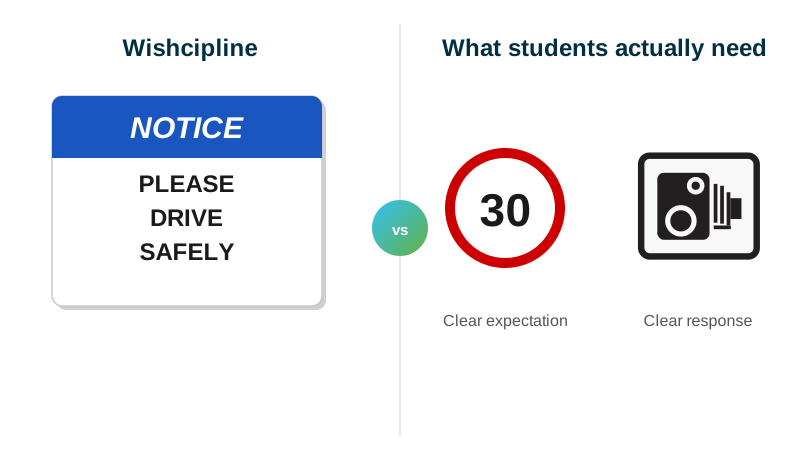
Most behaviour policies are not good. They are aspirational documents that describe values, reference research, and list consequences in a hierarchy that sounds robust on paper. What they almost never do is answer the two questions teachers actually need answered: what exactly should I expect from students, and what do I do in the moment when I don't get it?
Without those two answers, teachers nag. They shout. They repeat themselves. Not because they're bad teachers — because they have no system.
The Green Wig Test
I came back to school one September with a beard, having spent July clean-shaven. Around 1,400 people spent the first day telling me I had a beard. By the third day they were saying "you've still got your beard," as though the correct response was to immediately shave it off.
Now imagine I came in wearing a green curly wig. There would be a fuss. But imagine every member of staff came in wearing one on the same day. Within days, the green wig would simply be how things are here. Normal is a construct. It's made by what the majority do consistently.
Now imagine some staff start removing their wigs. Too hot. Doesn't match the outfit. The students who had long since stopped noticing start noticing again, because inconsistency is more visible than the original change.
That is what whole-school consistency is actually about. And the test is simple.
Ask a randomly selected teacher what happens when a student refuses a reasonable instruction. Then ask another. Then ask a lunchtime supervisor. Then ask a student.
If the answers are broadly similar, you have a system. If they're not, you have Wishcipline.
The problem isn't the policy. It's the adults who follow it on Monday and quietly ignore it by Thursday.
What to do
Stop asking "do we have a policy?" Start asking "do we have a practice?"
Those are different questions. The first is easy to answer. The second is the one that matters.
The Wishcipline gap isn't closed by writing a better policy. It's closed by training every adult in the building to use the same language, the same steps, and the same responses — consistently, including when it's inconvenient.